

The Evolution of Naval Mines
The use of mines as a military weapon has a long and complex history. Records of mines, explosive devices floating in water, date back to the Ming Dynasty. However, modern mines emerged during the American Revolutionary War, where explosive barrels were detonated upon collision with ships. Mines became formal weapons during the Russo-Japanese War, as electric detonators that exploded on contact and invisible “moored mines” submerged underwater caused successive sinkings of warships.
During World War I, the Allies created a “wall” of tens of thousands of mines in the North Sea to block German submarines. In World War II, advancements led to the development of mines capable of detecting warship sounds and magnetic fields. These innovations marked a significant shift in naval warfare.
The Impact of Mines in the Pacific War
During the Pacific War, the U.S. scattered tens of thousands of mines near Japanese waters. This strategy had devastating consequences, as hundreds of Japanese military and merchant ships sank, paralyzing maritime logistics. The import of wartime supplies and military provisions to overseas forces became impossible, pushing Japan to the brink of starvation. The U.S. code-named this mine operation “Starvation.”
After the war, Japan struggled to clear the mines scattered in its coastal waters. This experience enabled the Japan Maritime Self-Defense Force to acquire world-class mine-sweeping technology and capabilities. Following the Iraq War, Japan dispatched several mine sweepers to the Gulf region to remove mines, marking its first overseas operation post-war.
The Role of Mine Sweepers
A “mine sweeper” is a vessel designed to clear mines. Its development has kept pace with mine technology. Mines floating on the surface are detonated with machine guns, while submerged moored mines are neutralized by cutting their anchor lines or using small explosives. Mine sweepers are made of plastic to avoid triggering metal-sensitive mines.
Special sonar systems distinguish mines from rocks, and divers or unmanned equipment are deployed for more complex tasks. With the emergence of mines that fire torpedoes from the seabed, unmanned systems have become critical in mine-sweeping technology.
Current Challenges and Global Implications
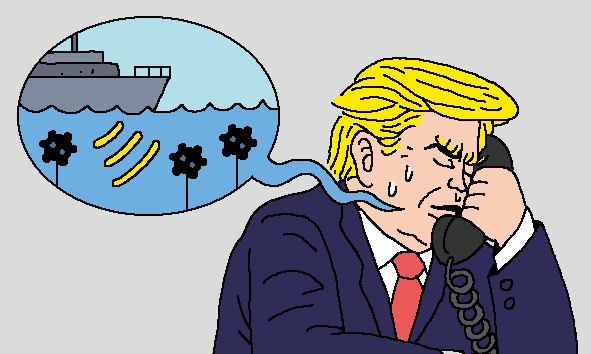
Amid Iran’s threat to block the Strait of Hormuz, Trump is seeking mine sweepers from allies, as U.S. naval mine-sweeping capabilities are insufficient. Even cheap floating or moored mines could sink billion-dollar oil tankers and U.S. warships. In terms of cost-effectiveness, mines surpass drones. Even aircraft carriers are immobilized without mine sweepers clearing paths.
The South Korean Navy has 12 mine sweepers, but they are smaller than Japan’s and below 700 tons, making long-distance voyages to the Middle East difficult. This highlights the importance of having robust and capable mine-sweeping vessels.
U.S. Navy’s Mine-Sweeping Capabilities
The U.S. Navy, unmatched globally, has long neglected mine-sweeping capabilities. It has few and aging mine sweepers. While reorganizing toward mine-sweeping helicopters and unmanned systems, it remains inadequate for clearing Iranian mines. Iran reportedly possesses thousands of mines; even dozens deployed could block the Strait of Hormuz.
It is astonishing and absurd that the U.S. initiated conflict without considering this. The reliance on mine-sweeping technology is crucial for maintaining maritime security and ensuring the free flow of commerce through vital waterways.
Membership Offers for News Readers
For news readers, there are various membership options available. A monthly membership costs 5900 won, while newspaper readers can enjoy it for 2900 won. The Chosun Membership offers access to 8 kinds of newspapers and magazines worth 55000 won. Members also receive 7000 points that can be used like cash for shopping, making it an economical choice for avid readers.