

The Drifting Russian Tanker: A Looming Environmental Crisis
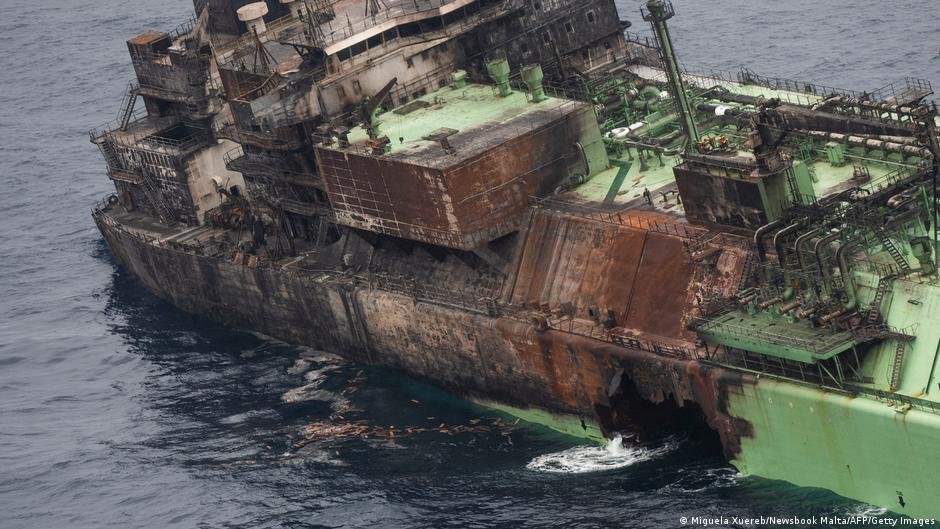
A Russian oil and gas tanker, the Arctic Metagaz, is currently adrift in the Mediterranean Sea with no crew onboard. This incident has raised serious concerns among environmental experts, who warn that if the vessel leaks, it could cause a devastating environmental disaster.
Until the evening of March 2, the exact position of the Arctic Metagaz was known — it was located east of the European island state of Malta. However, a few hours later, the ship’s tracking system stopped working, leaving its location unknown. According to the Russian Transport Ministry, the tanker was attacked by Ukrainian drones launched from the Libyan coast. Footage showed that the ship was ablaze and there was a large gash in its side. The ministry stated that all 30 crew members had been evacuated safely.
This week, Italian authorities reported that the unmanned tanker was drifting toward the Libyan coast, posing a significant risk of an environmental catastrophe. According to a spokeswoman for the Russian Foreign Ministry, the vessel, which has sustained considerable damage, is carrying 450 tons of heavy fuel and 250 tons of diesel, as well as “significant amounts of gas.” Explosions have been heard on board, she said, gas is leaking, and there are visible fires.
Essential to Bring the Ship Under Control
For Natalia Gozak, from the non-governmental organization Greenpeace, time is of the essence. “It is absolutely essential to bring the ship under control, pump it out, and sink it in a controlled manner,” she told . “If the oil and diesel leak, it will be devastating for the environment,” she added. “But of course, such an operation could be very dangerous — the large quantities of gas on board, estimated at over 60,000 tons, could explode.”
Gozak explained that the vessels of Russia’s shadow fleet — a clandestine network of what is thought to be thousands of ships operated to evade sanctions — regularly cause environmental damage. Russia has been purchasing used ships and re-registering them with new owners, managers, and flag states so that it can continue transporting the oil and gas that it produces.
“The tankers are often old, in poor condition, uninsured, and their tracking systems [put in place to avoid ships colliding] are turned off so they cannot be monitored,” said Gozak. “Furthermore, the tankers receive their cargo at sea, and oil is often spilled in the process.”
In a letter addressed to the European Commission President Ursula von der Leyen on March 18, the leaders of Malta, Italy, Spain, Greece, and Cyprus warned of the severe threat of a large-scale environmental disaster in EU waters and called for the EU’s civil protection mechanism to be triggered.
Implications for Law of War
Alexander Lott, a research professor at the Norwegian Center for the Law of the Sea, said the incident would also have implications for the law of war if it was confirmed that Ukraine was behind the drone attacks. So far, however, Kyiv has not commented on the matter.
“In the past, only the US and India have defined ships transporting certain goods, such as oil and gas, whose sale helps finance a war, as legitimate targets,” Lott told . “If Ukraine did carry out this attack, it would mean that it had aligned itself with this US position. Russia also appears to have done so, as demonstrated by attacks on merchant ships in 2022. In 2023, the Russian Defense Ministry stated that all cargo ships passing through the Black Sea to Ukrainian ports were potentially transporting war material. Thus, their flag states could be viewed as allies of the opposing Ukrainian side.”
Lott added that statements by Nikolai Patrushev, an adviser to Russian President Vladimir Putin, also pointed to an escalation. “He recently said that Russia would now send armed naval patrols to protect Russian merchant ships and might even equip the ships themselves with weapons,” said Lott. ‘Would they then automatically become legitimate targets of war?”
In recent months, Lott added, there had been reports of Russian military personnel on ships in the shadow fleet — by the Swedish navy among others.
Experts Fear Tanker Attacks Could Become More Frequent
Ian Ralby, an expert in maritime security and law, told he feared that attacks on tankers could become more frequent. “And both sides in the conflict [the war in Ukraine] now seem to be focusing on maritime traffic as well,” he said. He added that a similar situation was currently unfolding in the Strait of Hormuz, where several tankers have been bombed since the start of the US-Israel war against Iran.
Ralby said the incident highlighted the limitations of the sanctions against Russia. “They have now given rise to a parallel system involving many actors operating outside the framework of global trade governed by certain rules,” he pointed out. “We must, therefore, make the sanctions more effective — by building better relations with the countries doing trade with sanctioned states, for example.”
These included the members of the BRICS group of emerging economies such as India, Egypt, and Indonesia, he said.
According to Greenpeace’s Gozak, more needs to be done to address the shadow fleet and to tackle the root problem. “This situation could only arise because we are dependent on fossil fuels, a large portion of which still comes from Russia,” she said. “That is why we must switch to renewable energies. When we no longer need oil, Russian shadow tankers will no longer be a problem.”